|
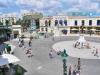
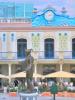
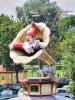
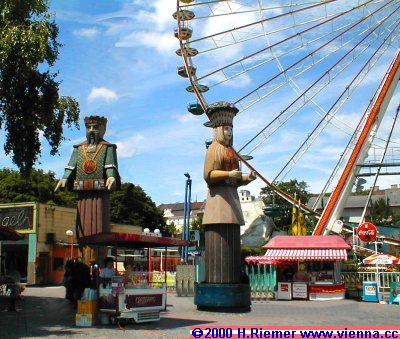
PraterThe Calafati The left of the two big statues is the *Big Chinese*.
Here in short
The history of Calafati
At the January 1, 1800 Basilio Calafati was born in Triest (now Italy) as son
of a carpet-merchant named Georg Calafati (1746-1837). From 1820 he appeared as "Salamucci" in the Prater, sold Emmentaler-cheese and Salami-sausage.Ten years later he got hired as assistant at a "Magician of the Prater", a magician originating from Bavaria named Sebastian von Schwanenfeld (1770-1845). On April 21, 1834 he bought from him the Praterhuette "Schiessstaette, Spielhalle" (gambling hall) for 1200 guilders. In the Kunstkabinett Hans Ringelmann, a taylor, worked as Bajazzo. After that Basilio Calafati bought from Katharina Martin a roundabout with wooden horses for 1300 guilders and applied to the Polizeioberdirektion (police dept.) for the concession to the run that caroussell, which was approved at the April 3, 1840.
On the occasion of the first steam - pursued railroad on the Nordbahn (Vienna - Wagram) on January 6, 1838, he removed the the horses 1844 through 2 locomotives, which he named "Hellas" and "Peking". After that he removed the upper floor of the caroussell-house, whereby the vacant mast was trimmed with a big figure. The sign on this 9m high figure called "Zum schwarzen Roessl" (To the black horse) (since 1802), and was called "Grosser Chineser" (Big Chinese) and from 1854 to 1945 it was the sign of the Wurstelprater. Beside the carrousel Calafati opened 1846 a restaurant and expanded it 1867 with a porch. Besides it was hall for events with artistic presentations as well as a billiard-salon.
Basilio Calafati died on May 27, 1878 in the house Prater No. 64. He was
consecrated in the church Pfarrkirche "Zur Hl.Dreifaltigkeit" and as
requested in his last will buried in the black wedding-suit on the St. Marxer
cemetery. In the Greek section of that cemetery a commemorative stone still
exists. On October 27, 1905 (with father Georg, wife Josefa and his five
children) he was exhumed and conveyed in a metal box to the Viennese cementary Zentralfriedhof. His grave is located at group 30C, row 6, grave 5.
Maria Calafati, wife of son Theodor Calafati, sold 1919 the enterprise to
Helene Pichler, born Kobelkoff. 1923 Alexander Kobelkoff received the ownership over a part of the cottage and wanted to remove the figure "Big Chinese" and wanted to build up a new etablissement. The Denkmalamt (memorial administration) intervened and 1922 finally resulted in a stop of the etablissement-plans.
Albert Kobelkoff 1932 restored the caroussell and the "Big
Chinese". There were 80m brocade cloth and for the 11m long braid 17kg
horsehair needed for the figure.
1935 the caroussell was set under protection. At that April 8, 1945 the
"Big Chinese" was destroyed.
On August 14, 1967 a copy of the "Big Chinese" by Ilse
Pompe-Niederfuehr was revealed, a plaque was revealed on May 20, 1968.
|