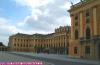
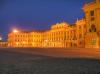
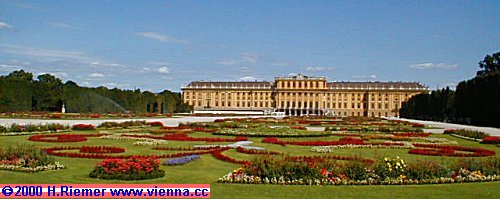
Palace SchoenbrunnInformation about the rooms in the castle Park-view to the castle
Read here about
Inside the palace Schoenbrunn
In the castle there are about 1400 rooms. Only 40 rooms are accessible for
visitors. Further interesting are the Wagenburg (emperors coaches), the gardens
and the Schoenbrunn Zoo. The rooms are designed in the style of 18th and 19th
century: Rokoko, magnificent floors, craftsmanship, eastasian elements,
corresponded to the fashion fo that time. In almost all rooms of the castle
there are magnificent ovens. This is remarkable, because Schoenbrunn was planned
to be a summer-residence, but the evenings in Vienna can be cool also in the
summer. The most ovens were heated from the backside. In the castle thus there
are narrow and hidden ways, from where the servants could heat the ovens without
disturbing the aristocrats. In almost each room are to be seen gilded ornaments
on the walls. Chiefly it corresponds with gold covered wood carving. In the
rooms there are also paintings with scenes from the castle Schoenbrunn. Van
Meytens was one the most important painters of Schoenbrunn.
The rooms
At the castle-tour there are about 40 rooms to bevisited. Remarkable is, that
some rooms were arranged in a specific style.
The guardroom (Gardezimmer)
A room in gold, in which the guard-soldiers received the orders of the
monarchs. The corps was responsible for the personal protection of the emperor
and/or the empress.
The billiard-room (Billardzimmer)
This room served for the relaxation, but also for private audiences of
emperor Franz Joseph I. Besides a Biedermeier Billiard-table for the waiting.
The walnut - room
Here emperor Franz Joseph I. sat at his desk and received the waiting from
the billiard-room to private audience. The room is in precious walnut-cover. The
wooden lustre is carved and covered with 24-carat-gold. Remarkable the ceramics
oven, the desk of the emperor and the inlaid work floor from 18th century.
The office-room of emperor Franz Joseph I.
This was dedicated for studies. Very interesting are the paintings.
Remarkable the painting of the empress Elisabeth, called Sissi. She was murdered
in Geneva in Switzerland.
The bedroom of emperor Franz Joseph I.
This shows the outlook of the emperor, who understood himself as uppermost
officials the. The bedroom is held in civil, one even say Spartan, plainness.
The bed of the emperor, in whom he/it died also, is held in @@schlichtem wood.
Interesting are the grandfather clock from the year 1795, a portrait of the
crown prince Rudolph, the painting "emperor Franz Joseph I. on the
deathbed" (F.V.Matsch painted it 24 hours after the death of the emperor)
and toilet - china from Bohemia. The toilet of the emperor was shown first 1993,
it includes an ashtray (emperor Franz Joseph smoked cigar).
The Porch-room (Terassenkabinett)
This room was dedicated to the empress Elisabeth (Sissi) and is named because
of the porch-connection to Valerietrakt, nother part of the castle. The walls
are covered with French silk from Lyon.
The Stairway-cabinett (Stiegenkabinett)
From this room a narrow flight of stairs led directly in the garden, the
Kammergarten. During the world war I the narrow flight of stairs was removed.
Today the room in red damask-tapestry on the walls contain eastasian
lacquer-boxes, a secretary with nacre-inlaids in the style of emperor Louis XV.
and paintings, which show Franz Stephan of Lothringen, princesses, a troupmarch,
a rider's fight and others.
The Toilette-room (Toilettenzimmer)
The walls are in "oldpink" brocade, a walnut-washing-dish with
white marble-plate, a standing mirror, a desk as well as several paintings and a
statuette of emperor Franz Joseph I.
The bedroom of emperor Franz Joseph I. and empress Elisabeth (Sissi)
The walls are covered with French silk from Lyon. The closets are made from
rosewood and it was presented by joiner's guild to the emperor end empress on
the occasion of their wedding. Emperors Franz Joseph I. was educated to joiner,
it was tradition that the Habsburger had to learn a craft. Remarkable is
prayer's chair, a watch from jaracandas with bronze-inlaids.
The drawing-room of the empress Elisabeth
This room belonged to the private rooms of the empress Maria Theresia. About
100 years later this room was the drawing-room of the empress Elisabeth. The
walls are papered with brocade, the furniture too, originated in the 18th
century. Interesting is the Chinese vase with silk lamp-screen, which was used
as table-lamp.
The Marie Antoinette - room
These rooms was named after Marie Antonia, which was called Marie Antoinette
after the wedding with @@Ludwig @@XVI. The room disposes of a dull - white
wood-cover with dullgold - decor with some paintings, among it also Marie
Antoinette.
The bathroom of the empress Elisabeth
The bathtub of white marble is furnished with a shower. Further there can be
seen a washing desk made of china. Remarkable is a hair-clamp, with which the
empress protected their long hair at the shower from dampness.
The Children's room (Kinderzimmer)
This room is in white and gold and was dedicated to the children of the
empress Maria Theresia. She had 11 daughters and 5 sons. Remarkable are the
paintings of an unknown painter.
The Breakfast-room (Fruehstueckszimmer)
From this room the emperor's family could look at the garden. Interesting is
the wall-décor with flowers in 26 Rokoko-frames, which were manufactured
presumably by Maria Theresia or their daughters, the eastasian china in the
wallconsoles and two green vases with ooze - decor from the 19th century.
The yellow drawing-room
Chairs and Chaiselongue are covered with yellow silk-damask. The walls are
trimmed likewise with gold, whereby the golden woodledges contrast to the white
walls. Remarkable the baroque box with a clock from gilded bronze and white
marble. The today still functioning clock shows the date, weekday and phases of
the moon and is more than 100 years old. Chinese motives can be seen on
Inlaid-work-box.
The Balcony-room (Balkonzimmer)
The white wooden wallcover with gold profiles and Festons is from the year
1854. In the corner is an oven fitting to the room, which likewise heated from
the backside. Remarkable paintings show the descendants of Maria Theresia:
Ferdinand Carl of Austria-Este, Leopold II., Maximilian Franz, Karl Joseph and
others.
The Mirror-saloon (Spiegelsalon)
In this room the ministers of Maria Theresia received orders. Wolfgang
Amadeus Mozart played here for the empress. Besides a small altar can be seen
with picture of the Virgin Mary. From 1747 this was the room of the princess
Charlotte of Lothringen, she was the sister of the empress Maria Theresia's
husband. Later this room was used for audiences of the empress Maria Josepha,
the second wife of Joseph II. After that in 19th century it was used as dining
room. Interesting are the crystal mirrors, which grant more size because of
their position, a bronze-watch from 19th century and a small altar and blue -
white vases made of china from the 19th century.
The large Rosa-room
This room is named after the baroque painter Josef Rosa. On the murals
landscapes are to be seen from Switzerland and Upper-Italy. Remarkable the
paintings of Maria Theresia and the ruin Habichtsburg (Habsburg) and a richly
trimmed clock on the wall-table and blue - white vases from East Asia.
The small Rosa-room
This room is named likewise after the painter Josef Rosa. Here are 6 large
paintings of Josef Rosa with rural scenes. Remarkably a Rokoko-clock with gilded
Bronze-decoration.
The small Rosa-room
This contains 5 landscape-paintings in the years 1763 - 1769, which are edged
in gilt frames. The picture "River with bridge" is a copy, because the
original was destroyed in world war II. Remarkable is selfportrait of the
painter.
The Latern-room (Laternenzimmer)
This room was a lobby to the large gallery and was a waiting-room for
servants and guests of the emperor, from where they were led homewards with
lanterns.
The round Chinese cabinet
Maria Theresia hindered here secret conferences since 1760. Emperor Franz
Joseph used this room for private purpose. This room contained a food-lift,
whose outlines still can be seen in the floor, besides there is a small
staircase to the premises the chancellor Kaunitz. Interesting are a enamel-lustre
manufactured in Vienna, eastasian vases and cans from the 18th century, Chinese
floorvases and the Lacque-fillings at the walls, which show eastasian landscapes
and flowers.
The large gallery
This room is 43m long and 10m high and is used for audiences by the emperor.
Maria Theresia authorized a reconstruction, whereby the hall became to the
center of the castle. Since 1761 occasions and ceremonies took place here.
Interesting are the paintings of the Italian painter Gregorio Guglielmi from the
year 1760-1761. The frescos on the ceiling show in the middle empress Maria
Theresia and their husband Franz I. and around agents the of the provinces as
well as displays of art, science and craft of war. The war-fresco was destroyed
in the world war II and was restored in the years 1947-1949.
The small gallery
In this room was for small dinings, concerts and theatre-plays. The exit
leads to the southern outside staircase with a beautiful view to Gloriette,
Neptune-fountain and the Blumenparterre. Over a arc this room is joined with the
large gallery. Remarkable are the busts the Marie Antoinette and Marie Carolina
made of carrara-marble and two wooden-carved and gilded lustres along with wall-girandols.
The oval Chinese cabinet
This room is arranged in Chinese style and contains eastasian lacque-boards
as well as china according to the fashion at that time.
The carousel-room (Karussellzimmer)
This room is named after a painting by Martin van Meytens, which shows the
Winterreitschule the k&k Hofburg (Hofreitschule - Riding school). Remarkably
beside the carrousel the painting of the empress Maria Theresia at the award the
St.Stephan-medal in the knight's room (Rittersaal) in the Hofburg (likewise from
Martin van Meytens).
The Horse's room (Roesselzimmer)
This room is named after the pictures painted on copper-metal showing horses
from the imperial stables by the Dutch brothers Hamilton. Remarkably the hunting
sceneries, originally this room was used as day nurseries / playing room. From
the 19th century this was the diningroom for the colonels the k&k-army as
well as the charges.
The Ceremonies-room (Zeremoniensaal)
This room was called originally Batagliensaal, whereby in the stucco contains
numerous elements of war like helebards and flags. In this room baptisms and
wedding-ceremonies were celebrated. Remarkable are the paintings like "the
public wedding-meal" from October 6, 1760 from the school of van Meytens
and "the music-festival in the Redoutensaal the Vienna Hofburg" from
October 10, 1760 (likewise from the school van Meytens). More scenes show the
solemn entrance of Isabella of Parma as bride of the crown prince at that
October 5, 1760 and the marriage of Joseph II. in the Augustiner-church at
October 6, 1760. To the painting "Musikfestival": On this picture
Wolfgang Amadeus Mozart and his father can be seen on the right edge of the
painting.
The blue Chinese drawing-room
This is arranged in eastasian style. The woodwork is from walnut with blue
admitted fields. The scenes painted on rice-paper show sceneries of the Chinese
life.
The Vieux-Laque - room
This room was useed by Maria Theresia after the death of her husband for
living. Interesting are eastasian lacque-boards and china and richly gilded
trimmings. Remarkable is the walnut-woodwork, which stucco-ceiling and the
wonderful with inlays manufactured parquet floor.
The Napoleon-room
In this room the birth of some of the 16 children of Maria Theresia took
place. Napoleon has lived here 1805 for 2 weeks, likewise also 6 months long
after his defeat at Aspern. His son, Duke of Reichstatt, lived here up to his
death through tuberculosis 1832. Remarkable are tapestries with sceneries of
roadhouse, smith, soldiers and fountain as well as a eastasian paravant and a
painting Franz Stephan of Lothringen.
The China-room (Porzelanzimmer)
This was originally the working cabinet of Maria Theresia. The about 200 blue
pen-and-ink drawings are allegedly from the emperor or from archduchesses.
Remarkable the blue-white garlands made of wood, with relieves showing emperor
Franz I., Elisabeth, Christians and Duke Albert of Saxony-Teschen; a Chinese
vase with blue-white flower-decor, and lustres and a clock made of Meissner
china.
The Millions-room or Vicatin-cabinet
This was originally a mirror-room. Maria Theresia redesigned it after the
death of her husband. Vicatin refers to the wall-cover from Central American
Roses-wood, which was original in the upper Belvedere, although also the name
Millions-room (Millionenzimmer) was common. Maria Theresia had audiences and
conferences in this room. Emperor Franz Joseph offered it to guests for living.
Remarkably the wood-cover with Rokoko-ornaments from 16. - 17. Century with
India-Persian miniatures, lustres with enamel-trimming, a oven-screen made of
roses-wood, a wall-table with Chinese vase and a Portrait-sculpture of Maria
Antoinette.
The Gobelin-room (Gobelinzimmer)
In this room gigantic gobelins are to be seen, which originate from Brussels
(18th century). They show a harbour-scenery with a horseman and a fish-market at
the harbor. Remarkable 6 Fauteuils covered with tapestry, which show the 12
months.
The Remembrance-room(Gedenkzimmer)
In this room there was a library, as can be seen at book-boxes. The
wall-décor is in white, gold and blue. Remarkable is the death mask of the Duke
of Reichstatt, which died at the age of 21 years in Schoenbrunn.
The red saloon
This room was a library-room. The name comes from the red damask on the
walls. The ceiling is grasped with golden stucco. The paintings show Joseph II.,
Leopold II. and Franz Joseph I. in young and late years.
The Terace-cabinett East (Terrassenkabinett Ost)
The painting shows Roses-girlands and an illusion of the heaven at the
ceiling. Remarkable is the console-table with copper-metal, which shows a
eastasian landscape in pearl-mosaic, black lacquer and pieces of copper.
The birthroom of emperor Franz Joseph I.
In this room emperor Franz Joseph I. was born in 1830. The four-poster bed
from red velvet originates from the Hofburg. empress Maria Theresia also had
audiences with ministers in this bed. Remarkable is a painting of Joseph II.
from the school van Meytens.
The office of the Archduke Franz Karl
The wall is papered with red damask, likewise the seats.
The saloon of the Archduke Franz Karl
The walls are papered likewise with red damask. Remarkable is the large
crystal-lustre and the paintings "Maria Anna", "Isabella of
Parma", "Christine and Leopold" and "Joseph and
Leopold" (all van Meytens), and a Parisean marble-statue from the year
1770.
The Bergl-room
Named after the baroque painter Johann Wenzel Bergl. He painted plants, palm
trees and parrots at the walls and mediated the impression of Indian jungle. The
wallfrescos were painted in the years 1768-1777, were covered by fabrics later.
1891 the fabrics were removed again.
|