|
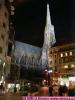
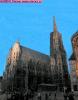
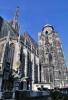
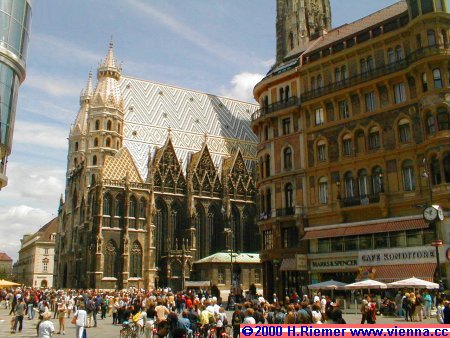
St.Stephan's CathedralView to square Stephansplatz Haashouse left, Erzbischoefliches Palais in the background, oblique view to cathederal
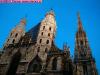
This gothic church is one of Vienna's signs. The big bell called Pummerin is in the smaller tower. Left the place near the Cathedral called Stephansplatz there is the socalled Haas-House.
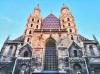
Originally the church was in romanic style, 1137-1147, or earlier (read next paragraph). From that time there is the big entrance-door and two towers, Heidentürme (1220-1250), at the side. The middle, the big hall of Choirs ("Albertinischer Chor", replaced the romanic choir), 1304-1340, the "Langhaus"., 1359-1450, the 137m high tower, 1350-1433, the 65m high "Adlerturm" (eagletower), 1450-1578 are constucted in gothic style. The outside facade contains tombstones, and measures for bread, roll and textile (the yard).
In April 2000 archaeologists found under the eastern part of the church the rest of longhousewalls from 11th century. So on that place of today's cathedral there already was a romanish church. With the discovery of a Hungarian arrow-head we know that this building can be dated on between 9th and 11th century.
Besides the entrance, the "Heidentor", is an engraving on the wall: O5. This is the name of a resistance movement against the Nazi-dictatorship. The meaning: O and that fifth character of the alphabet, results Oe -> Oesterreich/Österreich=Austria. Since 1944 it was painted on numerous walls at night.
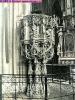
The gothic chancel at the northside contains a picture of the prayer Capistran. In the crosschappel (Kreuzkapelle) left after the entrance there is the grave of Prinz Eugens, died 1754, and plastics by Joseph and Ignaz Würschbauer and the marblealtar, 1731-1754. The altarcanopy at the northern Longhousewall is from Hans von Prachatitz, 1434. Also there is the Franz-Seraphikus-Altar, 1715, with a picture by J.M.Rottmayr. The cathedralchancel, 1514-1515, was constructed by the architect from Brno (now in Cechia) Anton Pilgram, who set himself a monument at the socle as "Fenstergucker".
In the northen Choir are tombstones, beside others of Cardinale
Melchior Khiesl, died 1630; the Wiener Neustädter Altar of 1447; the sarcophag of Balthasar Moll and the grave of Rudolf IV. with his wife Katharina, 14.century. At organ's bottom, worked out as carrierconsoles, are also a bust of Pilgram from the year 1513. The baroque altar from 1677 has a picture of Tobias Pock. At the
middle choir are a barouqe Sidealtar from 1772 by Martin Johann Schmidt (painter from Krems, called "Kremser-Schmidt", 1718-1801).
The big altar with artworks of Johann Jakob Pock is from the year 1640-1647. The baroque southern choir contains the grave of Kaiser Friedrich III, what he ordered already in his living days for 40.000 gold-dukates. The grave of Rotmarmorne (1467-1513) is there too. The marble baptismal font, 1481, contains relief works by Ulrich Auer.
At the southern longhousewall altarcanopy by Hans Puchsbaum from 1448; the baroque Dreifaltigkeits-altar, 1751, with a picture by Michelangelo Unterberger; the baroque pews from 1640-1645; the altarcanopy by Gregor Hauser and Jörg Oexl, 1510-1515.
In the duke-chappel there are the stone-statue of "Hausmuttergottes" (madonna) from 14.century and the tombstone by Andreas Feder with a picture of the oilhill, 1499.
In the middle hall there are the Dienstboten-madonna (domestic servant madonna; A rich countess impures a larceny of a necklace to a female domestic servant and called the police. The servant prayed to this early-gothic Madonna-Statue. The police was searching the house and found the necklace at a groom. The countess was blamed, she believed a wonder from the statue. She wanted to get the statue out of the house and presented it to St.Stephan's cathedral), 1320; the chancel by Anton Pilgram, 1515; the Johannesaltar with a painting by J.M.Rottmayr from 1708; the Januarisaltar with a painting by M.Altomonte, 1711; the Josefsaltar with a painting by Anton Schoonjans from 1700. On one of the columns in the middle
there is a copy of the "Madonna von Pötsch".
At the upper and lower vestry there is a painting by Martin Altomonte from the year 1732 and figures by Franz Xaver Messerschmidt from 1768.
Besides the Capistran-chancel there is the entrance to the catacombs. You can visit the count's tomb, it is a subterrenean system of corridors and chambers. The catacombs are used for graves since 1720.
The Steffl nearly would have been destroyed in World war II. From 10.April 1945 a Soviet sentinel was stationed in the tower for the observation of the fights at the Danube channel. Besides the Resistance-group O5 at the south side
of the tower had hoisted a white flag. To this point in time stood Captain Klinkicht as commander with a 8,8cm Flak-battery at the cliff of the mountain Bisamberg under the command of battery-officer lieutenant Ladanszky-Dewald. The flag caused the commander of the City Dietrich to give following order per radio-transmission to Cptn.Klinkicht: "As reward for the hoisting of the white flag on the Stephansdom the cathedral is to be put first of all with 100 shells in refuse and ash. If not destroyed shoot to it's entire destruction" Klinkicht announced the order as unworkable considering the distance of 14km and a destruction-range of 10-12km. As "Reichsdeutscher" he and his Austrian wife received indulgence. Klinkicht, born in Hanover (Germany), was honored as
rescuer of the Stephansdom, on April 23, 1997 14h30 o'clock even archbishop Christoph Schönborn unveiled a plaque in honor of Gerhard Klinkicht at the Curhaus, Stephansplatz 3. Klinkicht died in March 2000 in Palling (Bavaria) in the age of 86 years. Even when Klinkicht would have shot, he would have damaged the inner city, in which already the Soviets had inserted, heavily and met possibly with some flukes also the cathedral. Logically he would have had to shootfurther until entire destruction. The cathedral was in
fire-range, however not in destruction-range. Finally Klinkicht donated on the occasion of it 850-year-festival a remarkable sum of money.
Hardly the fate was averted, it happened then: In the night of 11th to 12th of April 1945 a spark of houses, which marauders set on fire, flew over to Stephansdom. The wooden truss burnt. From
the valuable chior only fragments were left. This is the more tragic, because the Steffl endured even the air raids of the Allies in March 1945 without larger damages. The bombs destroyed the main-waterpipe to the cathedral, this prevented an immediate extinction of the fire.
|